

Kijang Mas Tala (Kolaborasi Layanan Penunjang Penyelesaian Masalah Bidang Tanah Eks Transmigrasi) is a government land administration program that resolves a decades-old problem in Kabupaten Tanah Laut, South Kalimantan: land certificates still registered under the names of original transmigrants from the 1970s-80s, despite the land having been sold and occupied by different families for generations.
The Problem
In Tanah Laut's ex-transmigration areas, a widespread legal mismatch exists between who physically occupies the land and whose name appears on the certificate. Land was bought and sold informally — often without notarial deeds — over 20 to 40 years. The original transmigrant owners either passed away, moved away, or simply cannot be traced.
Under normal BPN procedures, a certificate transfer requires the original owner or their heirs to sign the transfer documents. With the original parties unavailable, residents were stuck in a legal deadlock: they owned the land in practice but could not prove it on paper.
Real consequences for residents
- No bank access. Land without a valid certificate in the occupant's name cannot be used as loan collateral.
- No inheritance. When the occupant passes away, their children face the same certificate mismatch.
- Lower land value. Informal ownership depresses the market price of the land.
- Constant dispute risk. Without legal certainty, competing claims can surface at any time.
- Previous cost: ~Rp20 million. Hiring a notary, lawyer, and pursuing individual court action was prohibitively expensive for rural families.
The Solution Architecture
Kijang Mas Tala solves this through a three-institution collaboration model backed by a digital integration platform (ISDN).
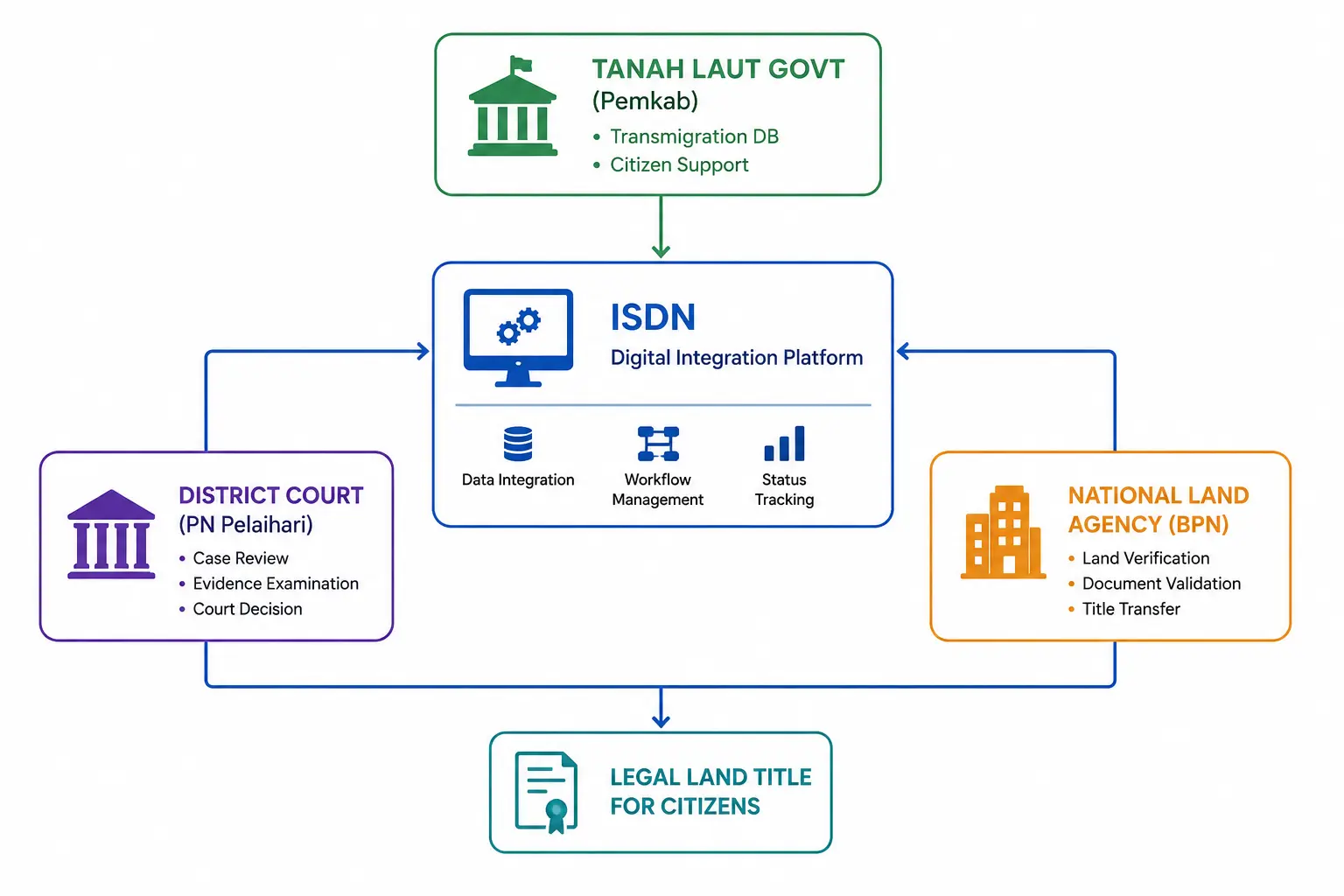
Three Institutions, One Workflow
| Institution | Role |
|---|---|
| Pemkab Tanah Laut | Provides the master database of ex-transmigration locations and affected residents. Funds facilities and operational support. |
| BPN Tanah Laut | Verifies each land plot is clean and clear (no disputes, not in restricted zones, cadastral data matches). Processes certificate issuance after court ruling. |
| PN Pelaihari | Conducts court hearings (including mass trials in villages), examines evidence, and issues legally binding rulings declaring the occupant as the rightful owner. |
The ISDN Digital Platform
ISDN (Integrated Services of the District Court and National Land Agency) is the technology backbone that makes the collaboration work at scale. It connects two previously siloed systems:
- SIPP — the court's case management system at PN Pelaihari
- BPN Administration — the land agency's certificate processing system
Before ISDN, a resident would win their court case, then start over with BPN — re-submitting documents, waiting for manual data entry, and having no visibility into either process. ISDN eliminates this fragmentation by making the court ruling flow directly into BPN's processing queue.
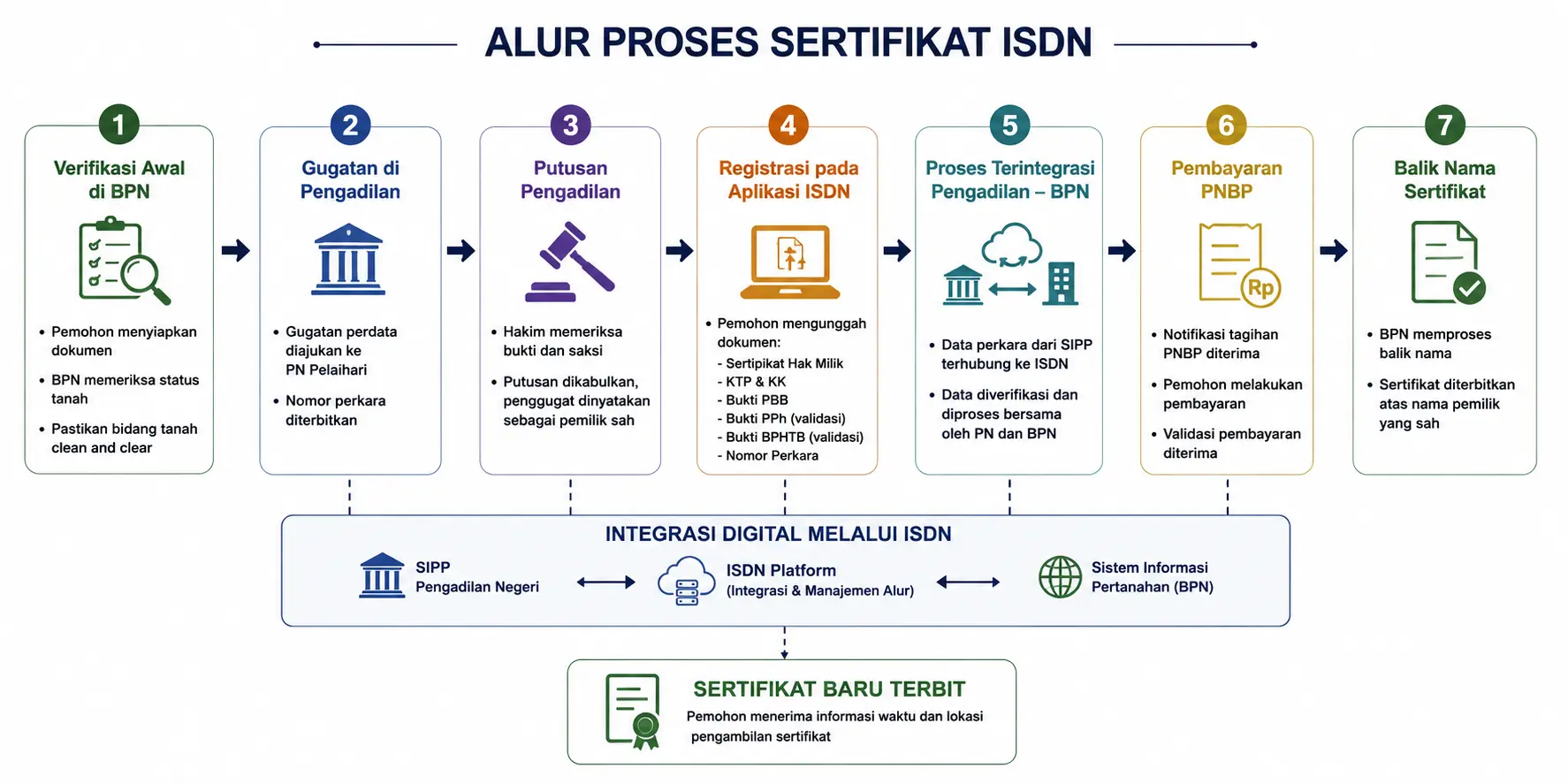
Upload requirements for ISDN registration
- Certificate (SHM)
- National ID card (KTP)
- Family card (KK)
- Proof of land tax payment (PBB)
- Validated income tax proof (PPh)
- Validated land acquisition duty proof (BPHTB)
- Court case number
How the Program Works
Village-Level Data Collection
Village government (Pemerintah Desa) identifies and registers residents who physically occupy ex-transmigration land. They collect the history of occupation, transaction records (even informal ones), and existing documents.
BPN Clean & Clear Verification
BPN Tanah Laut checks each identified land plot to verify it meets all requirements.
Court Filing and Mass Trials
PN Pelaihari conducts mass trial sessions in villages — judges, clerks, and equipment travel to the community rather than requiring dozens of rural residents to travel to the district capital.
Court Ruling
If the evidence is sufficient, the judge issues a ruling declaring the occupant as the rightful owner. This ruling becomes the legal basis for ownership transfer — replacing the need for the original owner's signature.
ISDN Processing
The court ruling is registered in the ISDN platform. Rather than the resident carrying paper documents between institutions, data flows digitally.
Certificate Issuance
BPN processes the ownership transfer and issues a new certificate in the occupant's name. The resident receives a WhatsApp notification when the certificate is ready for pickup.
Program Results
Kijang Mas Tala has produced measurable outcomes since its launch:
- Direct attention from the Minister of ATR/BPN — recognized at the national level as an innovative land administration model
- Kalsel Innovation Award 2023 — awarded 2nd place as one of the best regional innovations in South Kalimantan (see official announcement)
- Cross-district study visits — other districts with ex-transmigration areas (Barito Kuala, Hulu Sungai Utara) have sent teams to study and replicate the model
- New certificates issued for residents who had waited decades for legal ownership
- Cost reduction from approximately Rp20 million to Rp4.8 million per plot
Remaining Challenges
While the program is proven effective, several challenges persist:
Data Completeness
Many land transactions over the decades were conducted informally — verbal agreements or handwritten notes with no notarial deed. Reconstructing the full chain of ownership requires substantial field investigation and witness corroboration.
Evidentiary Requirements
Each case still requires credible witnesses and physical occupation evidence. If a resident cannot produce witnesses who remember the original transaction, the court may not have sufficient grounds to rule.
Scalability
The model requires active coordination between three separate institutions. As more villages enter the program, the capacity of BPN verification teams and court hearing schedules becomes a bottleneck that needs active management.
Awareness
Not all eligible residents know the program exists. Continuous socialization at the village level is necessary to reach the full population of affected households.
Recommendations for the Future
Several enhancements could strengthen the program:
- Digital database of ex-transmigration lands — a unified geospatial database integrating village, BPN, and court data for faster case identification
- Permanent service posts at sub-district level — rather than periodic mass trials, establish ongoing service counters at the kecamatan level
- Free legal assistance for low-income residents — village-level paralegals to help residents prepare documentation
- Priority mapping by case density — target villages with the highest number of unresolved cases first
- Post-certification monitoring — track newly certified land to prevent new disputes or informal sales that restart the cycle
Technology Stack (ISDN Platform)
The ISDN digital platform was built with a practical government-technology stack:
- Backend: PHP / Laravel — widely supported in Indonesian government IT environments
- Database: MySQL — compatible with existing government data infrastructure
- API Layer: REST API connecting SIPP (court system) and BPN administration system
- Notifications: WhatsApp Gateway for real-time resident updates
- Frontend: Web-based application accessible by all three institutions
- URL: https://isdn.tanahlautkab.go.id
Summary
Kijang Mas Tala solves the legal ownership problem of ex-transmigration land through a collaborative model between Pemkab, BPN, and the district court. ISDN solves the administrative fragmentation problem by building a digital bridge between the court and land agency systems.
Together, they transform a process that previously cost millions and took years into an integrated, transparent, and affordable workflow — giving residents of Tanah Laut the legal certainty they deserve over land they have occupied for generations.